
Helping farmers and barnacle geese co-exist along the Baltic coast
The BESTbelt project "TSIRK" revealed how non-lethal deterrence shifts migratory geese from farmlands to natural habitats—offering practical wins for both farmers and conservationists.
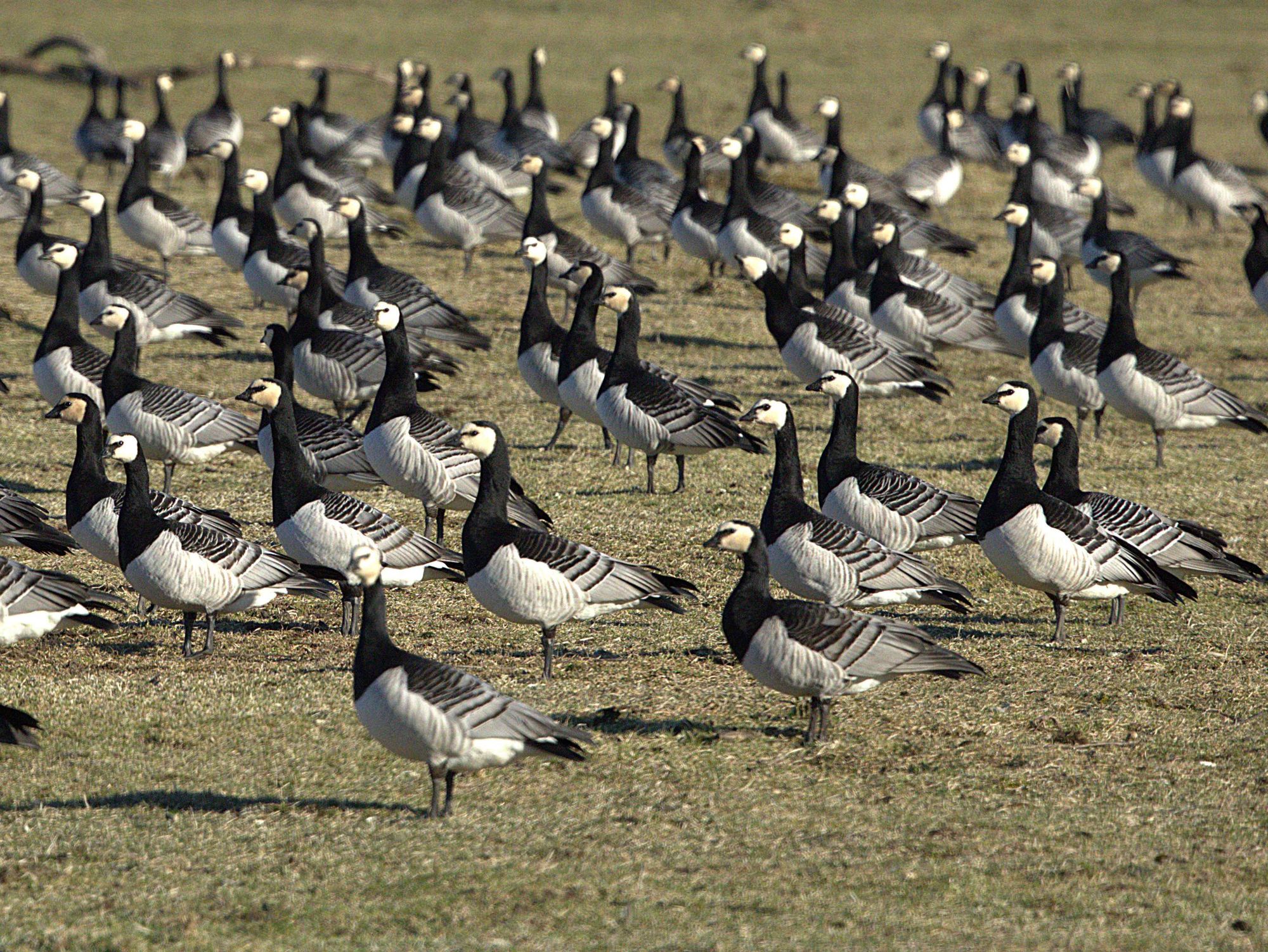
Along the Baltic coast, growing flocks of migrating Barnacle Geese have been landing on farmers' fields to feed — which often creates conflicts with local farmers as harvest is minimized or destroyed. On Estonia's Hiiumaa Island, researchers from the Estonian University of Life Sciences set out to find practical answers. As part of the EU-funded BESTbelt project "TSIRK", they did something never tried before in Estonia: they caught geese using a clap-net, fitted them with small GPS trackers, and worked directly with farmers to test whether drones could be used to scare the birds away from crops.
What they discovered was surprising. When the drone flew over, the geese didn't panic — they simply flew out over the Baltic Sea to retreat to a safer place for a while. Shortly after, the geese moved back to the main land, however as about twice as far away from their original feeding spots as before, and started feeding on semi-natural coastal grasslands instead close by, rather than on farm fields.
These results are good news for both farmers and conservationists: farmers now know the exact way how deterrence can help protect their. For conservationists, the study proves that maintaining well-managed semi-natural coastal meadows provides essential alternative feeding areas, allowing geese to replenish their energy while reducing pressure on farmlands.
The project "TSIRK – Thorough Study for Innovative and Respected Knowledge" was implemented by the Estonian University of Life Sciences from October 2024 to September 2026 and was funded by the BESTbelt project.
For more information, please contact: Contact: Henri Järv, Estonian University of Life Sciences, henri.jarv(at)emu.ee